The question

In NGC 253's starburst-driven galactic wind, do the two cones produce the same projected soft-X-ray thermodynamic structure at 8–12 kpc above the disk — when measured in apertures that are geometrically identical by construction rather than by argument

That is a single number

L ≡ log10SE / ΠNW) = ½·log10(N̂SE/N̂NW) + log10(kTSE/kTNW

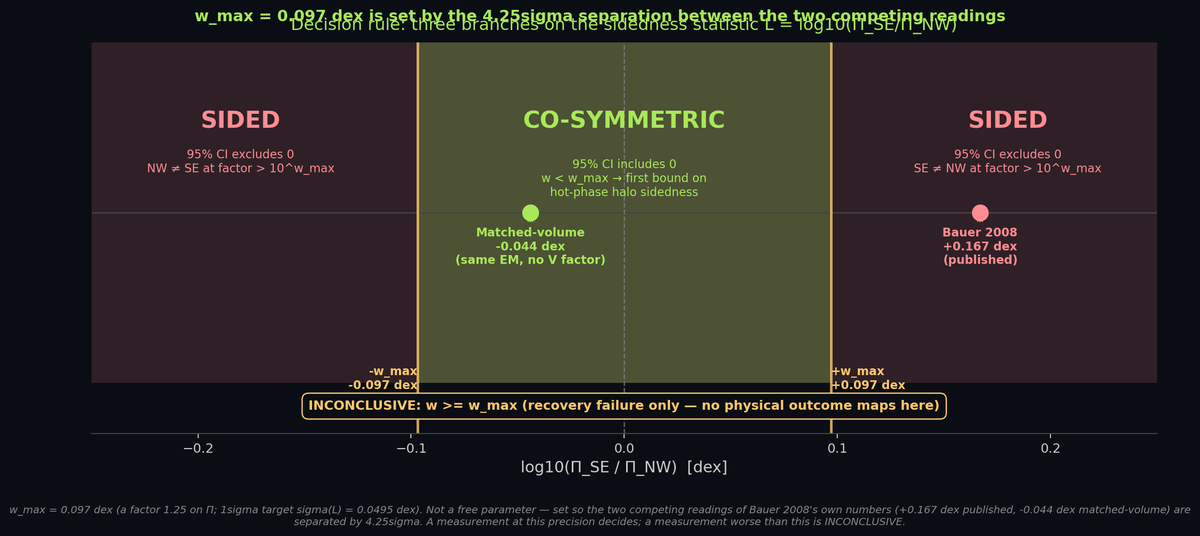
where Π ≡ √(N̂) · kT, N̂ is the fitted thermal-model normalization per unit solid angle in the matched wedge (projected emission measure per steradian), and kT is the emission-weighted temperature from the same fit. Both arms use the same model, the same response family, the same background contract, and geometrically identical apertures. The comparison is reported as a posterior median with a 95% credible interval of half-width w. Three outcomes are preregistered: SIDED (CI excludes 0), CO-SYMMETRIC (CI includes 0 and w < wmax), and INCONCLUSIVE (wwmax — recovery failure only, no physical outcome maps here

Why anyone should care

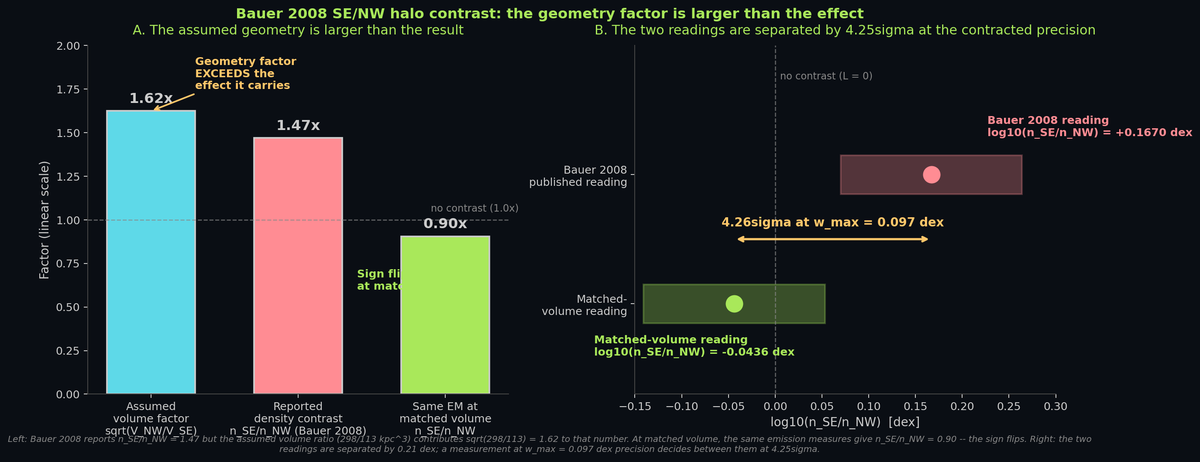
The one published answer is Bauer et al. 2008, A&A 489, 1029: the SE halo is softer than the NW halo, and the derived electron density ratio is nSE/nNW = 4.7η−0.5×10⁻³ / 3.2η−0.5×10⁻³ cm−3 = 1.47× (SE denser by 47%). That number is derived as n = √(EM/V) with assumed and unequal emitting volumes: VNW = 298 kpc³ versus VSE = 113 kpc³ (Bauer 2008 §3.2). The volume asymmetry alone contributes a factor √(298/113) = 1.62× to a reported effect of 1.47× — the assumed geometry is larger than the result it carries. At matched volume, the same emission measures give nSE/nNW = 0.90, i.e. the contrast changes sign

This is a real geometric effect, not a modelling choice that a cleverer re-analysis can undo. It is set by the aperture, and NGC 253 has a deep XMM halo pointing on the NW side (0723220101, PN 97.605 ks MEDIUM Full Frame, 2013-06-04, at 20.99′ from the nucleus at PA 328.7°) and nothing on the SE side, in any archive. Bauer's SE/NW comparison used the 2000–2006 on-nucleus data, whose SE and NW coverage is whatever fell in a field centred on the galaxy — which is precisely how it ended up with 298 vs 113 kpc³ apertures

Whose published conclusion changes Three concrete constituencies

  1. Anyone citing Bauer 2008's SE-softer halo as evidence that NGC 253's wind is environmentally shaped. The reported density contrast is smaller than the assumed-volume factor inside it, and flips sign at matched volume. That citation currently rests on an aperture choice
  2. Every single-cone hot-wind measurement — the norm beyond the Local Volume. They quote no cone-to-cone systematic because none has ever been measured. Either branch of this test supplies the first number for that error term
  3. Halo X-ray spectroscopy as a method Densities at halo scale are always √(EM/V) with V assumed. NGC 253 is the one system where the assumption can be removed by construction — matched point-reflected apertures — instead of defended in prose. What this measurement establishes about the size of the V-induced error is transportable to every other halo paper that makes the same move

Why both outcomes move the credence A SIDED result means the nearest resolved double-cone is genuinely sided in its hot phase at a measured amplitude, and that amplitude is the cone-to-cone systematic that single-cone work must start carrying. A CO-SYMMETRIC result at w < 0.097 dex means the contrast does not survive geometric control, and the answer is a quantitative upper bound of ≤25% on hot-phase halo sidedness — the first in any galaxy. That bound is the number a one-cone analysis then quotes. This is why the null deserves the time: it is a measurement, not an absence

What the measurement would look like

Bauer 2008 SE/NW halo contrast: the assumed-volume factor (1.62x) exceeds the reported effect (1.47x), and the contrast changes sign at matched volume
The prior result, decomposed Bauer 2008 reports nSE/nNW = 1.47×, but the assumed volume ratio (298/113 kpc³) contributes √(298/113) = 1.62× to that number. At matched volume, the same emission measures give nSE/nNW = 0.90× — the sign flips (left panel). The two readings are separated by 0.21 dex; a measurement at wmax = 0.097 dex precision decides between them at 4.25σ (right panel). wmax is not a free parameter — it is set by this separation. Verified: cycles/cycle-obs3/materials/I235_R2_geometry_20260825/i235_estimand.out §(A), SHA-256 d0a96084…
Three preregistered outcomes for the matched-aperture SE/NW sidedness statistic L
Three preregistered outcomes on L = log10SENW). SIDED: 95% CI excludes 0 (the contrast survives geometric control). CO-SYMMETRIC: 95% CI includes 0 and w < wmax (first quantitative bound on hot-phase halo sidedness in any galaxy). INCONCLUSIVE: wwmax — recovery failure only, no physical outcome maps here. The two Bauer readings (+0.167 dex published, −0.044 dex matched-volume) are marked; they fall on opposite sides of the CO-SYMMETRIC band, so a measurement at wmax precision discriminates them

What it looks like if the answer comes out the other way

If the result is CO-SYMMETRIC at w < 0.097 dex, the published SE/NW asymmetry does not survive geometric control. The answer is a quantitative upper bound of ≤25% on hot-phase halo sidedness at halo scale in any galaxy — the first such bound, and the finding that Bauer's reported contrast was carried by the assumed volumes, not by the data. This is not a boring null: it is a measurement that bounds a systematic every distant-galaxy wind paper currently ignores

If the result is SIDED, the contrast survives geometric control. The nearest resolved double-cone is genuinely sided in its hot phase at a measured amplitude, and that amplitude is the cone-to-cone systematic that single-cone work must start carrying. The cold molecular outflow (Bolatto et al. 2013, qualitatively S ≈ N) provides a qualitative contrast: SIDED hot + symmetric cold = multiphase decoupling; CO-SYMMETRIC hot + symmetric cold = multiphase coherence. Both are results

If the result is INCONCLUSIVE (wwmax), the page is honest about that. INCONCLUSIVE is reserved exclusively for recovery-target failure — σ(L) ≤ 0.0495 dex was not reached against the NW arm's fixed 97.605 ks cap. The most likely INCONCLUSIVE branch today is the response-folded recovery calculation returning "not reachable at any sane exposure" (gate I235-G3); if that happens, the idea dies on feasibility, and it should. The honest answer is not a failure of the page — it is the gate doing its job

Geometry — what the new observation looks like on the sky

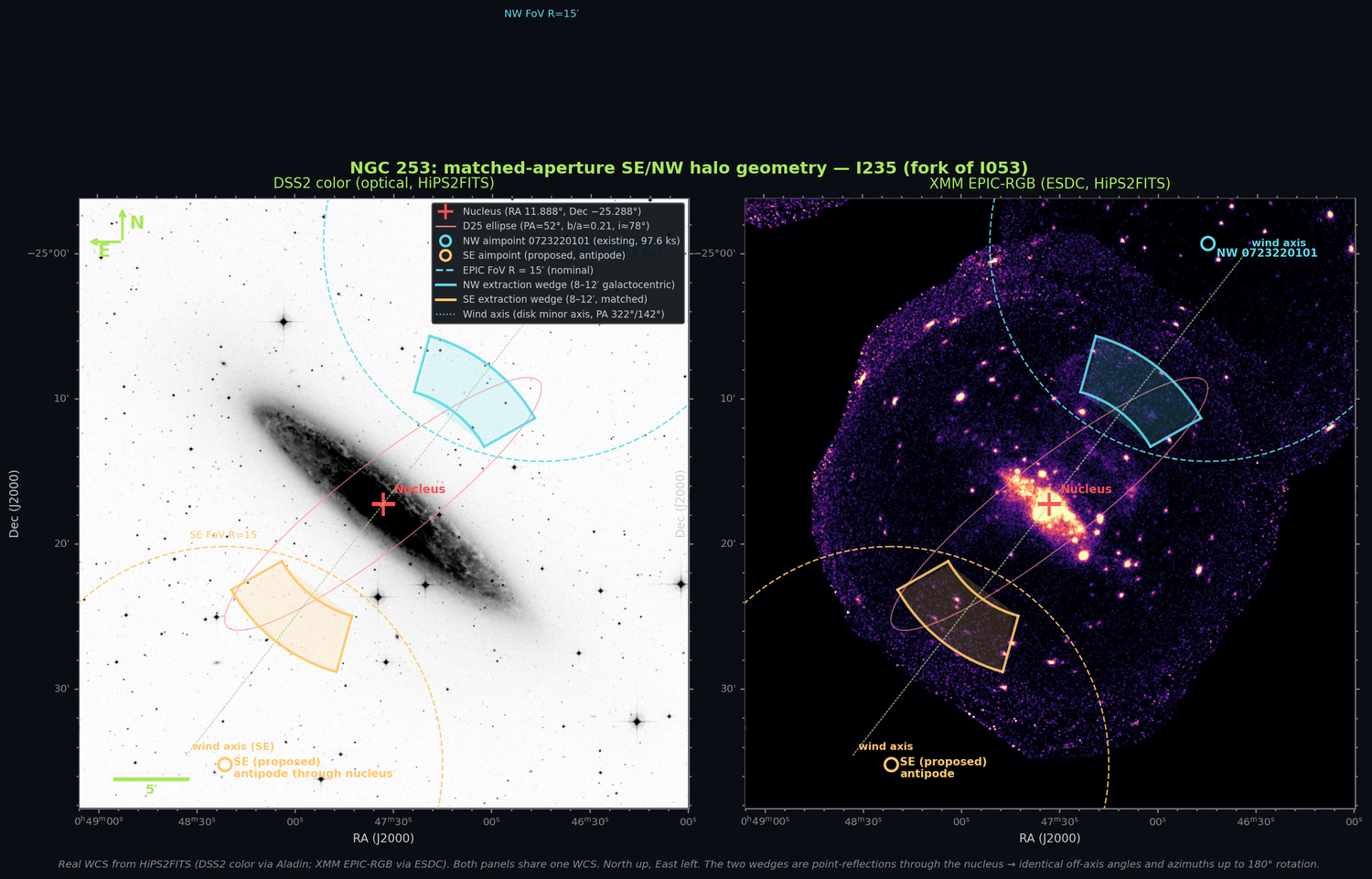
NGC 253 sky geometry on a shared 0.7 deg WCS: DSS2 color (left) and XMM EPIC-RGB (right), North up, East left
NGC 253 sky geometry on a shared 0.7° WCS (North up, East left). Left: DSS2 color HiPS2FITS (Aladin/P/DSS2/color, fov = 1.0°, 1200×1200). Right: XMM EPIC-RGB HiPS2FITS (ESDC/P/XMM/EPIC-RGB, same FoV/WCS). Overlays (both panels: red + = NGC 253 nucleus (RA 11.888°, Dec −25.288°); cyan circle = NW aimpoint 0723220101 (archival, 97.605 ks, 20.99′ NW at PA 328.7°); amber circle = SE aimpoint (proposed, great-circle antipode through the nucleus, RA 12.0895°, Dec −25.5868°, 20.99′ SE at PA 148.7°); pink ellipse = D25 at PA = 52° (b/a ≈ 0.21 from i ≈ 78°); dashed cyan/amber = EPIC FoV R = 15′ (nominal); dotted cyan/amber = wind axis (disk minor axis, PA 322°/142°); filled cyan/amber wedges = matched extraction regions (8–12′ galactocentric, 45° full wedge about the minor axis, 31.4 arcmin² per arm). The two wedges are point-reflections through the nucleus → identical off-axis angles and azimuths up to a 180° rotation. Verified: cycles/cycle-obs3/materials/I235_R2_geometry_20260825/i235_geometry.out, SHA-256 83628048…. Audit corrections applied (per the 2026-08-25 first-audit notes): East plotted LEFT (astronomical convention); wedges centred on the galaxy nucleus (galactocentric), NOT the pointing centre; SE wedge uses PA = 142° (not 322°); PA→matplotlib via WCS world_to_pixel, not manual rotation

The geometry is the R2 execution of the I053 fork. The proposed aperture is rin = 8.0′, rout = 12.0′, 45° full wedge about the disk minor axis on both arms. Correction to I053 carried by this fork I053 claimed a 7–12′ wedge "fully contained" with a 0.23′ margin. That check measured the half-angle from the nucleus→aimpoint line, so its worst corner sat at Δ = 22.5°. The wedge I053's own claim describes is centred on the minor axis (the wind axis its own claim names), which puts the worst corner at Δ = 22.5° + 6.7067° = 29.21°, and therefore at 15.27′ — outside the 15′ EPIC field. The minimum inner radius for a minor-axis-centred 45° wedge at Rfield = 15′ is 7.366′, not 6.727′. I235 moves to rin = 8.0′, contained on both arms with worst corner 14.54′ and margin 0.46′ at the nominal 15′ field radius

Why the antipode rather than "somewhere SE": the disk major axis is PA = 52°, so the wind axis is PA 322° (NW) / 142° (SE). The archival NW pointing 0723220101 sits 6.71° off the wind axis. Putting the new pointing at the exact great-circle antipode makes the misalignment between wedge centre and aimpoint direction −6.71° on both arms, identical to machine precision. The two matched wedges then sit at the same off-axis angles and the same azimuths relative to their own aimpoints, up to a 180° rotation — so the vignetting and ARF weighting across them match to first order. Any other SE aimpoint breaks that and reintroduces, as an instrumental term, exactly the kind of geometric asymmetry this design exists to remove

Containment is fragile to the usable field radius (gate I235-G1, blocking). Required rin for a 45° wedge with rout = 12′: R = 15.0′ → 7.37′; 14.5′ → 8.06′; 14.0′ → 8.78′ (the 8′ aperture fails; 13.0′ → 10.32′. A fallback ladder over half-angle 20°–45° is documented in the materials README §6. The design has a documented retreat, but the aperture is not frozen until the response-weighted usable radius is fixed from a response/exposure map rather than assumed

Why existing observations cannot answer it

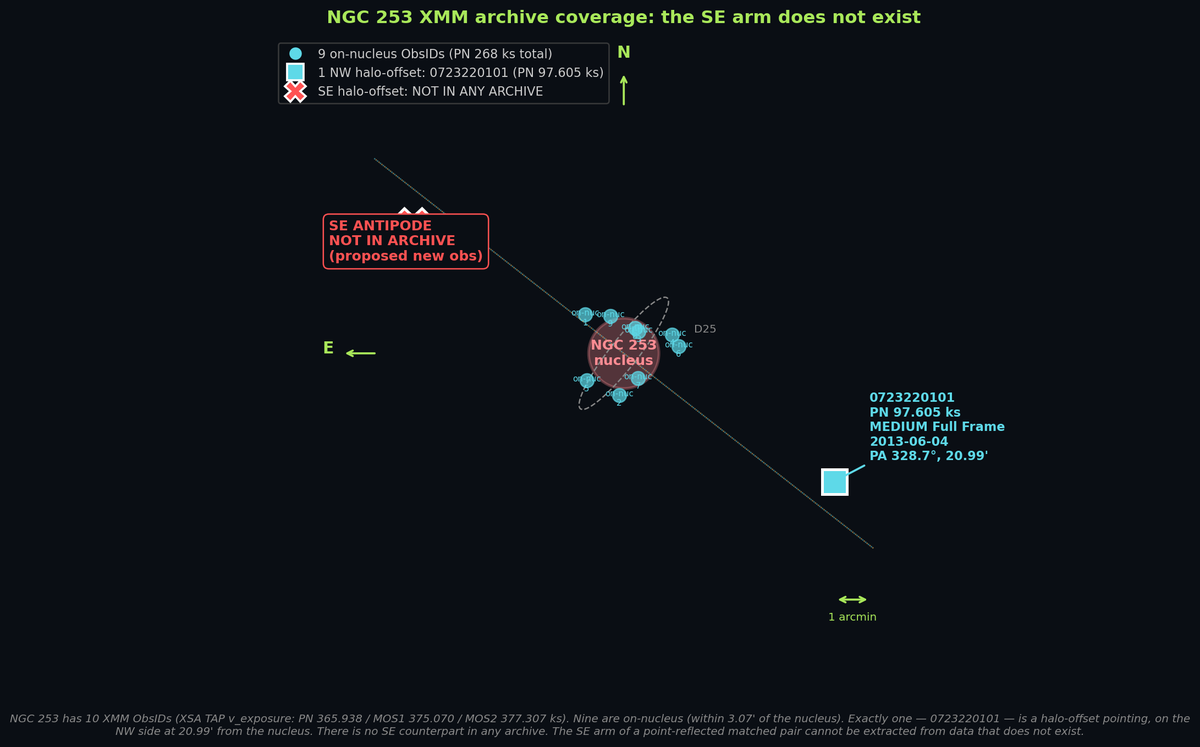
NGC 253 XMM archive coverage: 9 on-nucleus ObsIDs, 1 NW halo-offset, 0 SE halo-offset
NGC 253 XMM archive coverage. 10 XMM ObsIDs total (XSA TAP v_exposure: PN 365.938 / MOS1 375.070 / MOS2 377.307 ks). Nine are on-nucleus (within 3.07′ of the nucleus). Exactly one — 0723220101 — is a halo-offset pointing, on the NW side at 20.99′ from the nucleus at PA 328.7°. There is no SE counterpart in any archive. The SE arm of a point-reflected matched pair cannot be extracted from data that does not exist. Bauer's volume factor is not a modelling choice that a cleverer re-analysis can undo; it is imposed by where the telescope was pointed

Why XMM specifically (1) The NW arm is an XMM observation. A matched comparison needs the same response family on both sides; cross-instrument "unified" framings create the calibration term they claim to average away. (2) Effective area below 1 keV — Π is carried by the O VII/O VIII soft band; XMM's soft response is what makes a 5%-level measurement of N̂ conceivable at 8–12′ off the nucleus of a 3.5 Mpc galaxy at all. (3) The 30′-diameter field is what contains the aperture — the matched wedge at 8–12′ galactocentric, seen from an aimpoint 20.99′ away, reaches 14.54′ from that aimpoint. No other soft X-ray imager with comparable soft-band grasp holds it

Why not the existing archive Covered above: NW-only. A one-sided dataset cannot answer a two-sided question, at any depth

Why not eROSITA NGC 253 is at l = 97.37° — the eastern Galactic hemisphere, which is not in the eRASS1 public release. There is no eROSITA data for this target

Why not Chandra 18 archived ObsIDs totalling 457.210 ks, all on or near the nucleus, with no halo-offset mosaic (unlike M82's Strickland mosaic). The deepest (ObsID 20343, 153.600 ks ACIS-I) does not reach the SE halo aperture, and ACIS's soft effective area at 0.5 keV — with post-2010 contamination — is the wrong instrument for a faint diffuse soft-band normalization measurement regardless of pointing

Why not Suzaku 803004010 ("NGC 253 OFFSET") is a background pointing 18.2′ NNE of the nucleus at PA 37.6°; it is 30.2′ from the SE field, outside the XIS FOV, and covers neither halo arm. Suzaku's 2′ PSF would in any case not permit the point-source masking this measurement needs

What it costs — and what is still unknown about the cost

What we know: the geometry is executable (8–12′ wedge contained in 15′ EPIC field on both arms, verified to 4 decimals). The matched-aperture design eliminates the Bauer 2008 volume asymmetry by construction rather than by argument. The decision threshold is anchored: wmax = 0.097 dex is set by the 4.25σ separation between Bauer's published reading (+0.167 dex) and the matched-volume re-reading (−0.044 dex) of the same emission measures, not chosen freely. The σCX veto that blocked I002 and I053 does not transfer to a matched-aperture ratio estimand: a CX fraction common to both arms cancels exactly, and the worst-case differential inside the entire published M82 range gives |ΔL| = 0.044 dex = 0.46× wmax. The bound survives to fSE ≈ 0.40 (0.96× wmax) and fails only at fSE ≈ 0.45. Exposure is intentionally unsized by R2 — it must be derived by R6 from a response-folded recovery calculation against wmax, and may prove unreachable (see gate I235-G3

What I am deliberately NOT claiming (per the PI's audit, 2026-08-25):

  • One galaxy cannot "validate" a population-level or cosmological prescription NGC 253 is a single system. What generalizes is the methodological result (how large an error the assumed-volume step can induce) and the existence proof or exclusion of hot-phase sidedness at the nearest available resolution — not a per-cone loading factor η for the population. The I053 framing made that leap and the PI struck it
  • ne × kT from emission measure is a model-conditional pseudo-pressure, not a physical pressure A matched projected aperture is not an equal emitting volume. Reading L as a thermal-pressure ratio carries a stated ½·log10((ηL)NW/(ηL)SE) term; under (ηL)SE = (ηL)NW the second term vanishes, otherwise the pressure reading carries a √ of the path-length/filling-factor asymmetry. Every pressure statement in this idea is written with that conditional attached. This is the whole difference from I053, which called ne×kT a physical pressure and then contradicted itself
  • The M82 CX fraction is a prior on magnitude, not an NGC 253 hard systematic floor It flags risk; it cannot veto a proposal. The differential CX propagation replaces the inherited absolute-σCX veto (I002-E21 → SUPERSEDED-CLAIMED, handed to R4
  • Nominal circular FoV containment is provisional Detector footprints, chip gaps, vignetting, usable exposure and off-axis responses are what make geometry executable. Rfield = 14.0′ breaks the proposed 8.0′ aperture — that is gate I235-G1 and it is the blocking item

What we do not know: the exposure required for the SE pointing. R6 must derive it from a response-folded recovery calculation (per-camera ARF/RMF, ESAS QPB+SP+CXB background, source model grid, screening loss, effective area, preregistered precision with recovery curve and coverage). That calculation is the load-bearing deliverable (gate I235-G3, live descendant of I002-E27). Until it closes, any exposure number is unanchored. If the recovery calculation returns "not reachable at any sane exposure", this idea dies on feasibility, and it should

Gate ledger (D043 — single source of truth

GateStatusRole
I235-G1 OPEN — BLOCKING Response-weighted usable EPIC field radius Rfield, and the aperture freeze that follows. Blocks: freezing rin/rout/half-angle → any exposure derivation → any feasibility claim. Nominal R = 15′ admits rin ≥ 7.366′; R = 14.0′ breaks the proposed 8.0′. cycles/cycle-obs3/materials/I235_R2_geometry_20260825/README.md §6 and i235_geometry.out §5, §7
I235-G2 OPEN Matched extraction + background contract: source masking to a common flux limit on both arms, chip gaps, out-of-time events, wedge-averaged Galactic NH differential, and the 2013-vs-new-epoch QPB/SP/CXB differential. Blocks: the measured side of L and its σsys. …/README.md §10 (NH); T210 (EPIC background taxonomy); T216
I235-G3 OPEN Response-folded recovery: is σ(L) ≤ 0.0495 dex reachable, given the NW arm is capped at the archival 97.605 ks? Blocks: the CO-SYMMETRIC branch, the exposure request, and promotion of any kind. Live descendant of I002-E27. No HEAVY authorized
I235-G4 OPEN σΔCX, temperature channel. The norm channel is bounded at 0.46× wmax worst-case (below); the kT channel is unbounded and enters L linearly. Also adjudicates whether the inherited absolute-σCX veto transfers to a ratio estimand. Blocks: the σsys budget on L, not the aperture. i235_estimand.out §(B); T239, T240, T241, T242, T218; shared/DISAGREEMENTS.md D001; shared/OPEN_NUMBERS.md N1; I227
I235-G5 OPEN Residual (ηL) asymmetry between point-reflected apertures — the bound that makes the conditional pressure reading quotable rather than merely caveated. Blocks: the pressure interpretation of L only; does not block the sidedness claim. T69 (i ≈ 78°, 60° cone); T103 (H I extent
I235-G6 OPEN Bauer 2008 original-PDF verification of nNW/nSE, VNW/VSE and the kT-similarity statement, and a pre-emption re-check for any matched-aperture NGC 253 SE/NW halo comparison published since 2008. Blocks: the headline motivating result and the novelty claim. Inherits I002-E26 (never closed). T156; shared/sources/I002_bauer2008_se_nw_halo_intake.md; i235_estimand.out §(A
I002-E24 CLOSED — RESOLVED-NEGATIVE (inherited Suzaku 803004010 overlap with the SE aperture. Non-blocking; retained as provenance so the question is not re-asked. cycles/cycle-4/evidence/I002_suzaku_803004010_overlap.md; T70
I002-E21 SUPERSEDED-CLAIMED (inherited; R4 to adjudicate I235 asserts the absolute-σCX veto does not transfer to a matched-aperture ratio estimand and replaces it with I235-G4 (differential). R2 asserts the argument, not the closure — R4 rules. Until then this row is not treated as blocking. i235_estimand.out §(B); cycles/cycle-obs1/r5_adjudication.md §§1–4

What the inherited σCX veto does and does not show

I002-E21's blocking arithmetic set σCX = 0.25 — an absolute soft-band CX flux fraction measured in M82 at the 11.6 kpc Cap (T239) — against a 0.102 ratio threshold, and reported 2.45×. That comparison has no propagation step in it. For a ratio between matched apertures of the same galaxy, a CX fraction common to both arms cancels exactly; what survives is the differential, ΔL = ½·log10((1−fSE)/(1−fNW)). Taking the worst case inside the entire published M82 range — fSE = 0.25 against fNW = 0.08, i.e. the two sides maximally decorrelated across the full 8–25% span — gives |ΔL| = 0.0444 dex = 0.46× wmax. The bound survives to fSE ≈ 0.40 (0.96× wmax) and fails only at fSE ≈ 0.45. Verified in cycles/cycle-obs3/materials/I235_R2_geometry_20260825/i235_estimand.py, SHA-256 874cf228…, §(B

Three things this argument does not claim: (i) it bounds the norm channel only — the kT channel is gate I235-G4 and remains open; (ii) it does not measure σΔCX for NGC 253, which nobody has (T241: no published paper quantifies CX for diffuse volume-filling halo plasma at ≳10 kpc in any galaxy); (iii) the "SE/NW cancellation is weakened by the Lopez+2023 inner asymmetry" counter recorded in D001/N1 rests on transferring a central ~1 kpc result (−1.1 to +0.63 kpc) out to 8–12 kpc — which T218 explicitly forbids for that same paper in the opposite direction. It cannot be non-transferable when it would help and transferable when it would block. The differential is unmeasured in both directions, which is why it is carried as a bounded nuisance parameter fitted per arm rather than as an imported floor or an assumed cancellation. Gate I235-G4 adjudicates; R2 asserts no closure

Why this page exists

I235 is the PI-mandated successor to I053 (PI_REVIEW.md row 1, 2026-08-25, verdict REDO_PAGE / NOT_CONVINCED; carried into I053 frontmatter as next_stage: new_idea by R5 Judge seat 1). The PI kept the core — a mirrored SE pointing re-testing Bauer 2008's SE/NW halo contrast in MATCHED PROJECTED APERTURES, plus hot/cold-phase sidedness against Bolatto's symmetric molecular outflow — and struck four over-extrapolations: (1) one galaxy cannot validate a population-level symmetric-injection prescription; (2) ne×kT from emission measure is a model-conditional pseudo-pressure; (3) the M82 CX fraction is a prior on magnitude, not an NGC 253 hard systematic floor; (4) nominal circular FoV containment is not response/extraction feasibility. I235 rebuilds the claim around a model-free projected sidedness statistic, demotes the physical-pressure reading to an explicitly conditional interpretation, replaces the absolute-σCX veto with a propagated DIFFERENTIAL CX term, and repairs the containment error I053 carried but did not detect

HEAVY is paused (PI, 2026-08-23). An idea does not reach compute by asking for it — it reaches compute by being written up as a page the PI reads and approves. This page is that artifact for I235

Provenance

  • Idea file: shared/ideas/I235_ngc253-matched-projected-aperture-pseudo-pressure-sidedness.md
  • R2 Admission: cycles/cycle-obs3/r2_admission_fourth.md
  • R2 Geometry script: cycles/cycle-obs3/materials/I235_R2_geometry_20260825/i235_geometry.py (SHA-256 1336caba1277d2e8bc4f817386a47294b10eb01068758df45a4934f7b29b4eb4
  • R2 Geometry output: cycles/cycle-obs3/materials/I235_R2_geometry_20260825/i235_geometry.out (SHA-256 836280485bb1347e63b27c8f73429dcb82320220001a9c043ff8a3ce7bb6ee00
  • R2 Estimand script: cycles/cycle-obs3/materials/I235_R2_geometry_20260825/i235_estimand.py (SHA-256 874cf2284cf16f92a42e94548f6b821943a6dbb6ca4c68240f3143b034b41dc9
  • R2 Estimand output: cycles/cycle-obs3/materials/I235_R2_geometry_20260825/i235_estimand.out (SHA-256 d0a9608427ba455184f8bf6590b8547f2fee8c2b4dde460a623f923b999aa26a
  • Bauer 2008 source card: shared/sources/I002_bauer2008_se_nw_halo_intake.md
  • Coverage matrix: shared/survey/coverage-matrix.md L16
  • HiPS2FITS source FITS: CDS/P/DSS2/color and ESDC/P/XMM/EPIC-RGB, fetched 2026-08-26 from https://alasky.cds.unistra.fr/hips-image-services/hips2fits (fov = 1.0°, 1200×1200, ICRS

Geometry replay command (used to compute antipode, containment, and wedge geometry):

python3 cycles/cycle-obs3/materials/I235_R2_geometry_20260825/i235_geometry.py

Result: 0723220101 sits 20.9925′ from the nucleus at PA = 328.7067°; exact great-circle antipode = (RA 12.0895°, Dec −25.5868°), 20.9925′ at PA = 148.7067°; I053's 7–12′ wedge worst corner 15.2694′ (NOT contained); I235's 8–12′ wedge worst corner 14.5433′ (contained, margin 0.4567′

Estimand replay command (used to compute the Bauer decomposition and the differential-CX propagation):

python3 cycles/cycle-obs3/materials/I235_R2_geometry_20260825/i235_estimand.py

Result: Bauer nSE/nNW = 1.4688 contains √(VNW/VSE) = 1.6239 from assumed volumes; at matched volume nSE/nNW = 0.9044 (sign flips); the two readings differ by 0.2106 dex; wmax = 0.097 dex separates them at 4.25σ; worst-case differential CX (fSE = 0.25, fNW = 0.08) gives |ΔL| = 0.0444 dex = 0.46× wmax