01 · The Question

A question understandable to colleagues in another subfield

At projected heights of 8–12 kpc above the disk, do the two sides of the NGC 253 biconical superwind have the same soft X-ray thermal phase structure? The comparison no longer relies on the assumption of "equal volumes for two regions"; instead, it uses projected apertures strictly matched by point reflection through the nucleus.

The number to be measured

𝔏 ≡ log10SENW) = ½ log10(N̂SE/N̂NW) + log10(kTSE/kTNW)

where Π ≡ √N̂ · kT; N̂ is the APEC normalization from the same thermal model fit, normalized by extraction solid angle, and kT is the temperature from the same fit. 𝔏 is the projected sidedness statistic; only under the additional condition of equal path lengths and filling factors on both sides can it be interpreted as a thermal pressure ratio.

02 · Why It Matters

The published conclusion of Bauer et al. (2008) exposes exactly this gap

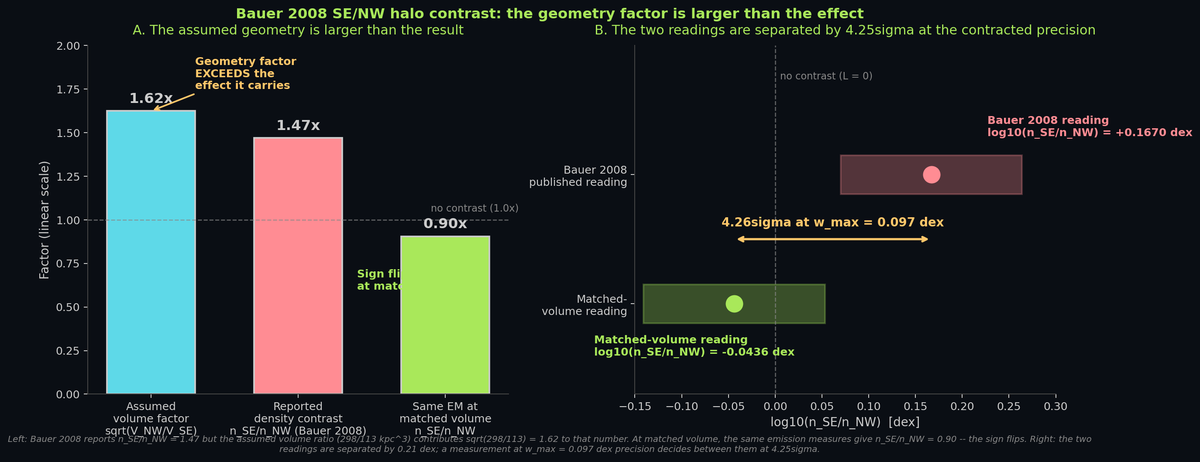
Bauer et al. 2008, A&A 489, 1029–1046 reported that the SE halo of NGC 253 is softer than the NW halo, and derived nSE/nNW = 1.47 from n = √(EM/V). However, this number used unequal assumed volumes: 298 kpc³ for NW and 113 kpc³ for SE. This volume ratio alone introduces a geometric factor of √(298/113) = 1.62, larger than the 1.47 effect it supports; placing the same emission measure into matched volumes yields a reading of 0.90, flipping the sign.

This is not a small correction that can be eliminated by refitting: the original apertures were determined by where the telescope happened to point. Bauer's historical comparison used core-pointed data; while the deep XMM offset observation suitable for halo-scale matching exists only on the NW side—no SE counterpart exists in the archive.

Whose conclusions would change?

  1. Work citing Bauer et al.'s "SE softer/denser" to explain the wind environment asymmetry of NGC 253: its density conclusion carries a volume factor larger than the conclusion itself.
  2. Studies of distant starburst galaxy winds that can only resolve a single cone: there is currently no measured cone-to-cone thermal phase systematic error to cite.
  3. All X-ray spectroscopy interpreting √(EM/V) as halo density: NGC 253 provides a direct test that can remove aperture-imposed volume differences from the comparison.

What this page does not claim

A single galaxy cannot validate cosmological feedback or population-level "symmetric injection" prescriptions. What is transferable is the methodological magnitude: how much bias an assumed volume introduces into a two-sided halo comparison; not the loading factor of any galaxy class.

Bauer 2008 SE/NW halo density comparison: the assumed volume factor of 1.62 is larger than the reported 1.47 effect; with matched volumes the reading is 0.90.
Checkable decomposition of the published result. Left: Bauer et al.'s volume assumption contributes a factor of 1.62, while their reported density contrast is only 1.47; using the same EM with matched volumes yields 0.90. Right: the two readings are +0.1669 and −0.0436 dex, separated by 0.2106 dex. The wmax = 0.097 dex in the figure is set by the 4.25σ separation of these two competing readings, not a free parameter.

03 · What Is Actually Measured

Turning "which side is stronger" into a continuous, falsifiable measurement

Result LabelPre-registered CriterionScientific Meaning
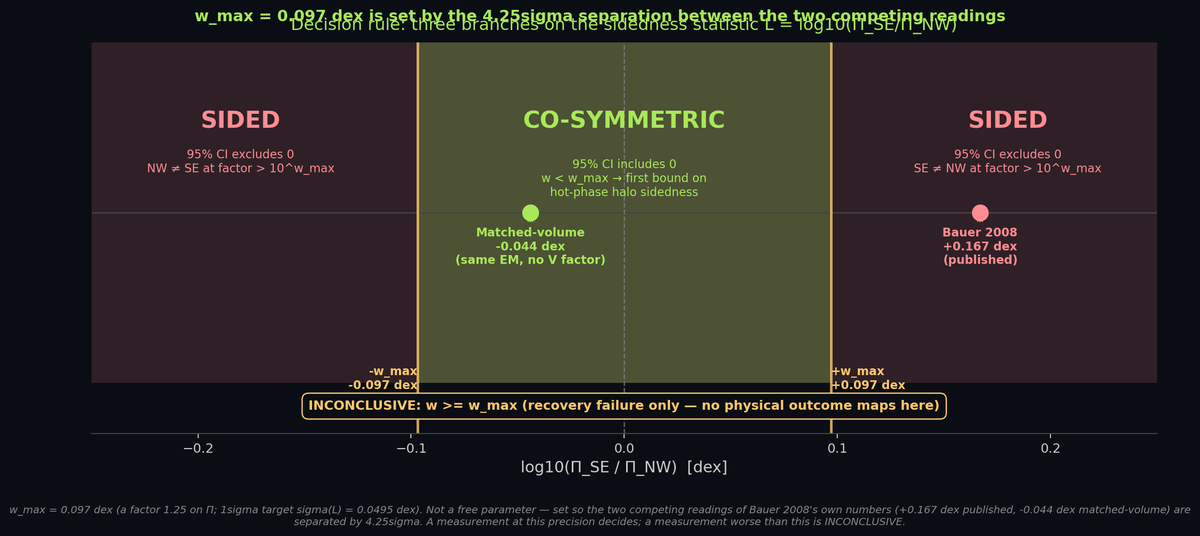
SIDED 95% credible interval of 𝔏 excludes 0 The projected thermal phase structures of the two cones differ within this matched aperture; Bauer's asymmetry persists after geometric control and can be quantified in amplitude.
CO-SYMMETRIC 95% interval includes 0, and half-width w < 0.097 dex The two cones agree at this precision; provides a ≤25% quantitative upper limit on thermal phase halo sidedness, rather than "seeing nothing."
INCONCLUSIVE w ≥ 0.097 dex Only indicates that the recovery precision target was not met; no physical result is forced into this branch.

The precision contract is wmax = 0.097 dex, corresponding to a 1.25× factor on Π and a 1σ target of σ(𝔏) = 0.0495 dex. The continuous value 𝔏 and its interval are always reported; the labels above are aids to interpretation and do not replace the numerical result.

Pre-registered decision rule for I235: SIDED, CO-SYMMETRIC, and INCONCLUSIVE branches of the sidedness statistic L, with thresholds such as w_max.
Decision rule, not post-hoc classification. The two threshold lines are at ±0.097 dex. The red dot is Bauer's published reading; the green dot is the re-read value with matched volumes using the same EM. INCONCLUSIVE corresponds only to recovery precision failure and cannot be treated as physical "no difference."

04 · What It Looks Like on the Sky

Full FoV for coverage audit; science zoom for actual extraction region audit

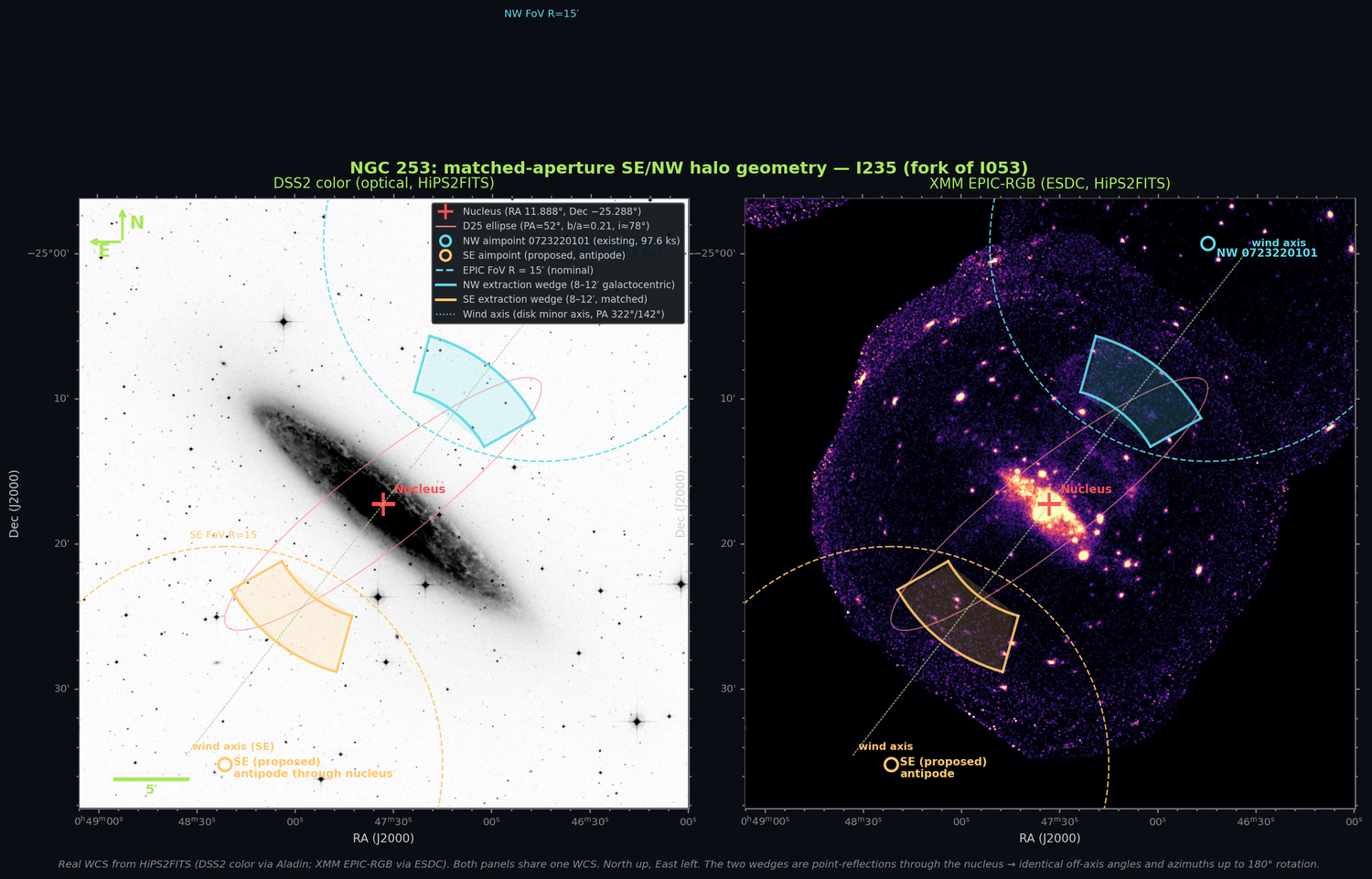
The existing NW observation 0723220101 is 20.9925′ from the nucleus at PA = 328.7067°. The proposed SE pointing is its exact great-circle antipode through the nucleus: RA = 12.0895°, Dec = −25.5868°, also 20.9925′ at PA = 148.7067°. This is not a planar reflection; the two differ by 3.36″, which cannot be mixed in the ARF geometry of such vignetted apertures.

Geometric QuantityFrozen Value or Current Status
Wedge centers on both sidesDisk minor axis: NW PA = 322°; SE PA = 142°
Wedge shape45° full opening angle; rin = 8.0′, rout = 12.0′; 31.416 arcmin² per arm
Nominal FoV testAt Rfield = 15′, farthest corner at 14.5433′, margin 0.4567′
Critical constraintIf the response-weighted usable radius is only 14.0′, the 8.0′ inner radius fails; one must fall back to the documented half-angle / rin ladder.

Image notes: All panels use the same real HiPS2FITS WCS with CRVAL at the NGC 253 nucleus, CDELT1 < 0, CDELT2 > 0; thus North up, East left is guaranteed by WCS, with no hand-written PA→image coordinate transform. The XMM RGB uses a single-intensity asinh stretch after positive intensity p0.5–p99.5 clipping, scaling all three RGB channels by the same factor; this is for display only. Dark gray indicates zero coverage, distinct from faint surface brightness; raw WCS coverage, display stretch, exposure correction, and scientific flux are four different concepts.
Four-panel real WCS map of NGC 253: DSS2 and XMM EPIC-RGB 30-arcmin full field of view and 8-arcmin science zoom; North up, East left, marking the nucleus, D25, two FoVs, wind axis, and matched wedges.
Two working scales with real WCS. Top row: 30′ full FoV showing the complete EPIC 15′ radius field, both offset centers, and their nominal FoVs. Bottom row: 8′ science zoom showing the measured 8–12′ wedge. Cyan is the existing NW 0723220101; amber is the proposed SE antipode; filled wedges surround the minor axis of the nucleus, not the pointing center. Right column XMM RGB has display-only asinh stretch; dark gray is zero coverage.

05 · Why the Archive Cannot Answer

The gap is not "insufficient depth"—one arm simply has no corresponding data

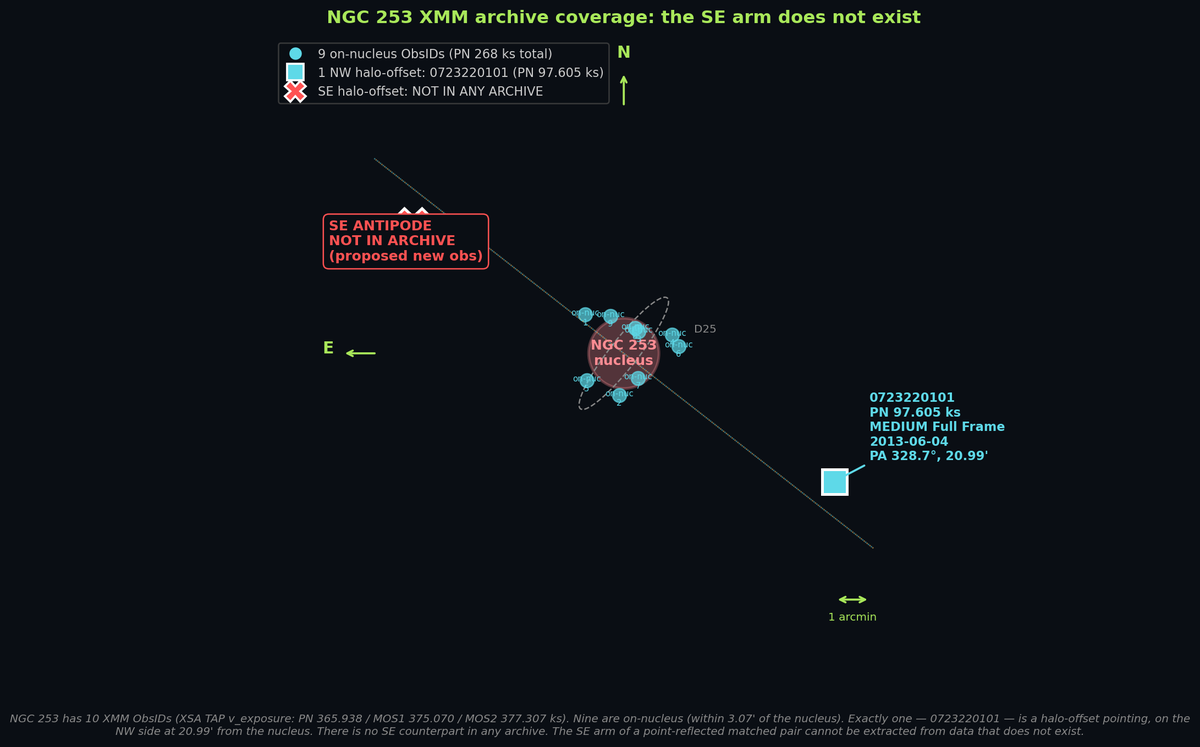
NGC 253 has 10 XMM ObsIDs; 9 are within 3.07′ of the nucleus, and only one is a halo-offset observation—the NW 0723220101 (PN 97.605 ks, 2013-06-04, MEDIUM Full Frame). There is no SE halo-offset counterpart. No matter how deep, single-sided data cannot construct a point-reflected matched SE/NW pair.

Why XMM

The control arm is already XMM EPIC; both sides must maintain the same response family to avoid introducing cross-instrument calibration terms. The information in Π is mainly in the O VII/O VIII soft band; only XMM's soft response and 30′ diameter FoV can simultaneously accommodate this halo-scale aperture.

Why not other archives

Chandra's 18 ObsIDs also lack a halo-offset mosaic; the deepest ACIS-I 20343 does not cover the SE aperture. Suzaku 803004010 is an NNE background pointing that covers neither arm and its 2′ PSF is unsuitable for this problem. eRASS1 has no usable public coverage in this region.

XMM archive coverage schematic of NGC 253: 9 core-pointed ObsIDs, one NW halo-offset 0723220101, and no SE halo-offset.
Structural gap in archive coverage. This figure shows XSA TAP-verified coverage classification, not an event-level exposure map: 9 core-pointed ObsIDs, 1 NW halo-offset, 0 SE halo-offsets. The red X is not a measurement result but the empty slot of the proposed new pointing in the existing archive.

06 · If the Answer Is the Opposite, Is It Still Worthwhile

Both physical outcomes have clear interpretations; what can truly fail is feasibility

If SIDED

The published difference persists after geometric control. The result is a measured cone-to-cone structural difference amplitude for this galaxy, at this projected scale, in this thermal phase; future studies that can only observe a single cone finally have an empirical systematic error magnitude to cite.

If CO-SYMMETRIC

Not "nothing there." Under w < 0.097 dex, it provides a ≤25% quantitative limit on thermal phase halo sidedness and shows that Bauer's density contrast is mainly driven by the aperture-imposed volume term.

If INCONCLUSIVE

This means the recovery calculation or actual data did not meet the agreed precision; no physical interpretation is assigned. If response-folded recovery confirms that the target is unreachable with reasonable SE exposure, the correct conclusion is that the idea died from feasibility and should not be packaged as a null result.

Bolatto et al. (2013)'s CO(1–0) wind is roughly evenly split in S/N, serving only as a qualitative cold-phase control: if the thermal phase is SIDED while the cold phase is roughly symmetric, it suggests multiphase decoupling; conversely, it suggests coherence. That paper does not provide an SE/NW molecular flux ratio usable for this page, so it does not enter the likelihood, wmax, or any significance statement.

07 · Cost and Unknowns

Exposure time cannot be quoted now; this is the most important honest limitation of this page

The new observation shape is an XMM EPIC SE halo-offset pointing, with mode and filter intended to match 0723220101's Full Frame / MEDIUM. However, the required SE exposure has not yet been derived. It must be computed by response-folded recovery for σ(𝔏) ≤ 0.0495 dex, and the 97.605 ks on the NW side is a precision ceiling that cannot be extended.

Open GateWhy It Blocks the Current Request
I235-G1 (blocking)The true usable EPIC field radius must be defined with response/exposure maps; within the nominal 15′ circle does not equal extractable given chip gaps, vignetting, OOT, and CCD state.
I235-G2Common source masks, backgrounds, and QPB / soft-proton / CXB differences between 2013 and the new epoch for both arms have not yet been established.
I235-G3Response-folded recovery has not yet shown the target precision is achievable; it determines whether a reasonable exposure time exists.
I235-G4Bounded arithmetic exists for differential CX effects on the normalization channel, but the CX effect on kT is still unbounded; kT enters 𝔏 linearly.
I235-G5 / G6Respectively, the pressure interpretation of residual path-length/filling-factor asymmetry, and the final pre-emption check of Bauer's original PDF and subsequent literature.

Cost Conclusion

What can currently be requested from the PI is approval of the value judgment to continue the recovery / response work required by the Gates, not an observing request containing fictitious ks numbers. Any version that writes a specific exposure time here is not credible.

08 · Provenance and Boundaries

What this page is based on and what it cannot represent

  • Bauer, M. et al. 2008, XMM-Newton observations of the diffuse X-ray emission in the starburst galaxy NGC 253, A&A, 489, 1029–1046, DOI 10.1051/0004-6361:20078935; arXiv 0711.3182.
  • Bolatto, A. D. et al. 2013, The Starburst-driven Molecular Wind in NGC 253 and the Fate of the ISM, Nature, 499, 450–452, DOI 10.1038/nature12351.
  • Geometric numbers come from deterministic replay of fixed inputs: great-circle antipode, 45° wedge, nominal 15′ radius containment, and the 1.62/1.47/0.90 volume factor decomposition. The WCS inputs in the figures are DSS2-color and ESDC XMM EPIC-RGB HiPS2FITS products obtained on 2026-08-26.

Publication boundary: This is a communication page for PI review; it is not an EPIC reduction, response/exposure qualification, flux measurement, feasibility closure, HEAVY authorization, or proposal-ready conclusion. Display stretch does not participate in any scientific quantity calculation. All Gate statuses are still subject to the project's canonical idea ledger.